
Blog · October 1, 2026
After a Florida Storm: How to Check Your RV Roof for Damage
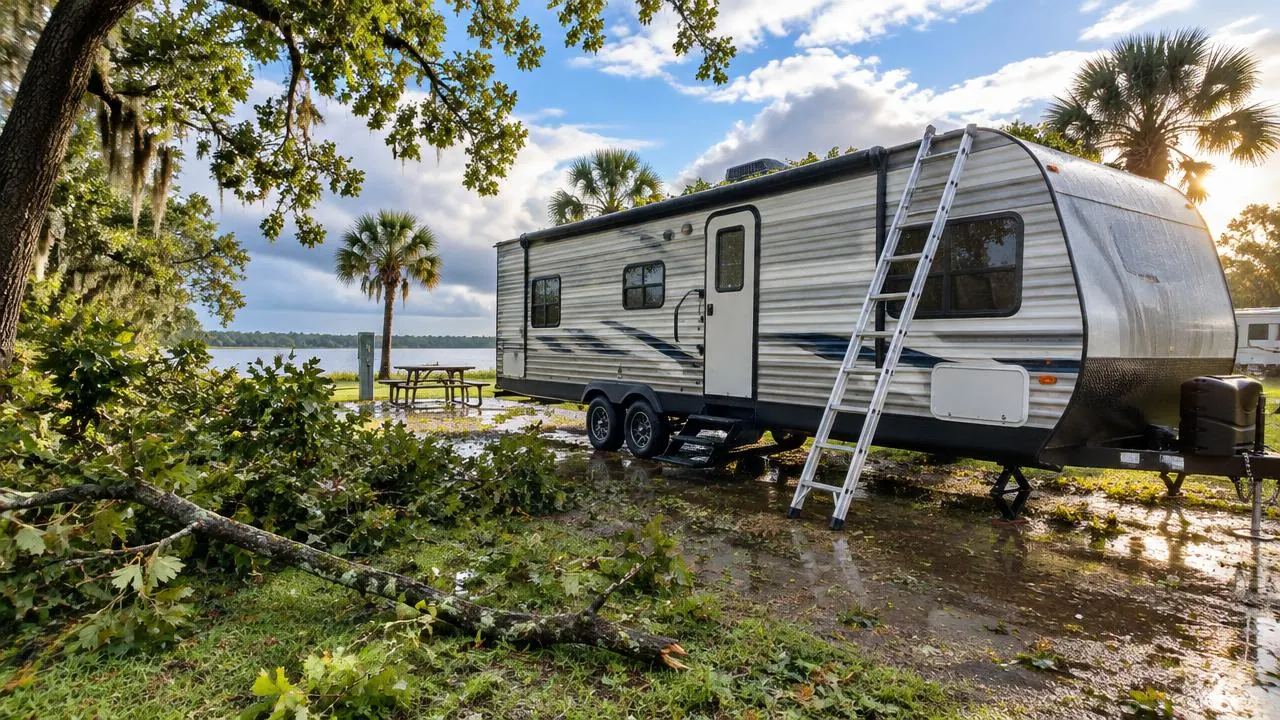
In Tampa Bay, the storm usually passes in an hour. The sun comes back out, the puddles start steaming, and it is tempting to forget about it. But summer afternoon storms here bring hard, sideways rain and gusts that throw branches and debris around. If your RV sat through one, the hours after it is the best time to take a look, because the next storm is often only a day away.
This is a simple, safe routine you can follow yourself. You do not need special tools. You need a good ladder, a phone for photos, a flashlight, and a little patience.
Start with safety, not the roof
Wait until the roof is completely dry. A wet RV roof is slick, and many roofs are not built to carry a person's full weight everywhere. If you are not sure your roof is walkable, do not walk on it. You can see a lot from the top of a ladder.
- Set the ladder on firm, level ground, never on soft wet grass that can sink on one side.
- Keep three points of contact and do not lean out past the rails.
- Check for low branches or power lines before you climb, especially if the storm knocked limbs loose.
- Move the ladder along the sides and both ends so you see the whole roof instead of stretching to reach.
Walk the outside first
Before you climb, walk all the way around the RV at ground level. Look at the roof edges from below. Lifted trim, a loose edge, or a piece of roof material flapping in the breeze is easy to spot from the ground and tells you where to look first once you are up the ladder. Look on the ground too. Bits of plastic from a vent cover, chunks of sealant, or pieces of trim lying near the RV are clues.
What to look for on top
Work slowly from one end to the other. Take a photo of each area as you go, even if it looks fine. Those photos become your before pictures for the next storm.
- Seams: look for any line where the roof material has lifted, wrinkled, or pulled apart.
- Front and rear caps: these take wind head on. Check where the roof meets the cap for gaps.
- Vents and fans: make sure each cover is still in one piece and sitting flat. A cracked cover can let rain straight in.
- Skylights: look for cracks in the dome and for any space opening between the frame and the roof.
- The A/C unit: check that the shroud is intact and that the area around its base looks the same as before.
- Antennas, solar mounts, and anything else bolted down: look for movement or new gaps around the base.
Branches and debris
If a limb landed on the roof, do not drag it off. Lift it straight up if you can do it safely, or ask for help. Dragging a branch can turn a small scuff into a long tear. Once it is off, look closely where it landed. A puncture can be as small as a pencil point and still let in water. Leaves and pine straw packed against a vent or along an edge hold moisture against the roof, so brush them off gently with a soft broom.
Now check inside
The roof can look fine from the top and still be letting water in. Go inside with a flashlight and look up.
- Look at the ceiling around every vent, skylight, and the A/C for fresh stains or rings.
- Check inside overhead cabinets, especially the back corners against the outside wall.
- Press lightly on the ceiling near the front and rear. Soft or damp spots matter.
- Use your nose. A sudden damp smell after a storm is worth paying attention to.
Mark anything you find with a small piece of painter's tape and take a photo. If a stain grows after the next rain, you will know.
Take good photos
Photos help whoever repairs the roof understand what happened and where. Take a wide shot of each section, then a close one of anything that looks off. Shoot the inside stains too. Keep them together in one album with the date of the storm.
When to call before the next rain
Some things are fine to watch. Others should be handled before the next storm, because water will keep finding the same opening.
- Any puncture, tear, or lifted seam.
- A cracked vent cover or skylight.
- A new stain inside that was not there before.
- Anything you cannot see clearly or reach safely.
If you find something and rain is on the way, a temporary tarp tied down from the ground can buy you time, but do not leave it on for weeks. Trapped moisture under a tarp causes its own problems. Get the real repair done as soon as you can.
The short version
Wait for the roof to dry, walk the outside, look from the ladder, check every opening, look inside, take photos, and act on anything that is open before it rains again. Ten careful minutes after a storm can save a lot of wood later.
If you found something you do not like, or you just want a second set of eyes on it, we come to you anywhere in the Tampa Bay area. Call or text us and tell us what you saw.
Need a hand with this? Call or text (813) 455-5206.
See our RV Roof Repair and Leak Repair service